
When a pipe bursts, an HVAC drain backs up, or stormwater enters a property in Tampa Bay, the first priority is not cosmetic repair. The first priority is water mitigation: stop the source, remove water, and dry the structure before permanent restoration begins.
TL;DR: Summary
- Water mitigation comes first, and restoration comes after. In Tampa Bay water damage cases, the correct order is moisture control, extraction, drying, cleaning, then repair or rebuild.
- The EPA says the key to mold control is moisture control, and water-damaged materials should be dried within 24-48 hours to help prevent mold growth.
- ANSI/IICRC S500 treats drying, psychrometry, safety, and preliminary restoration evaluation as core water-damage procedures, which is why mitigation starts before finish work.
- If the water source is not fixed first, mold remediation and restoration can fail because wet drywall, insulation, subfloors, or framing can stay contaminated.
- In Tampa, St. Petersburg, Clearwater, Brandon, Riverview, Wesley Chapel, Lakeland, and Spring Hill, fast action matters because heat, humidity, and storm season can speed up secondary damage.
That order matters even more in Florida’s climate, where moisture lingers in wall cavities, under flooring, and inside air handlers. For homes and commercial properties across Hillsborough, Pinellas, Pasco, Polk, and Hernando counties, the practical question is not whether mitigation or restoration matters more, but when each should happen.
What are the key takeaways about water mitigation and restoration?
Water mitigation must happen before restoration in Tampa Bay because drying and moisture control determine whether repairs will last.
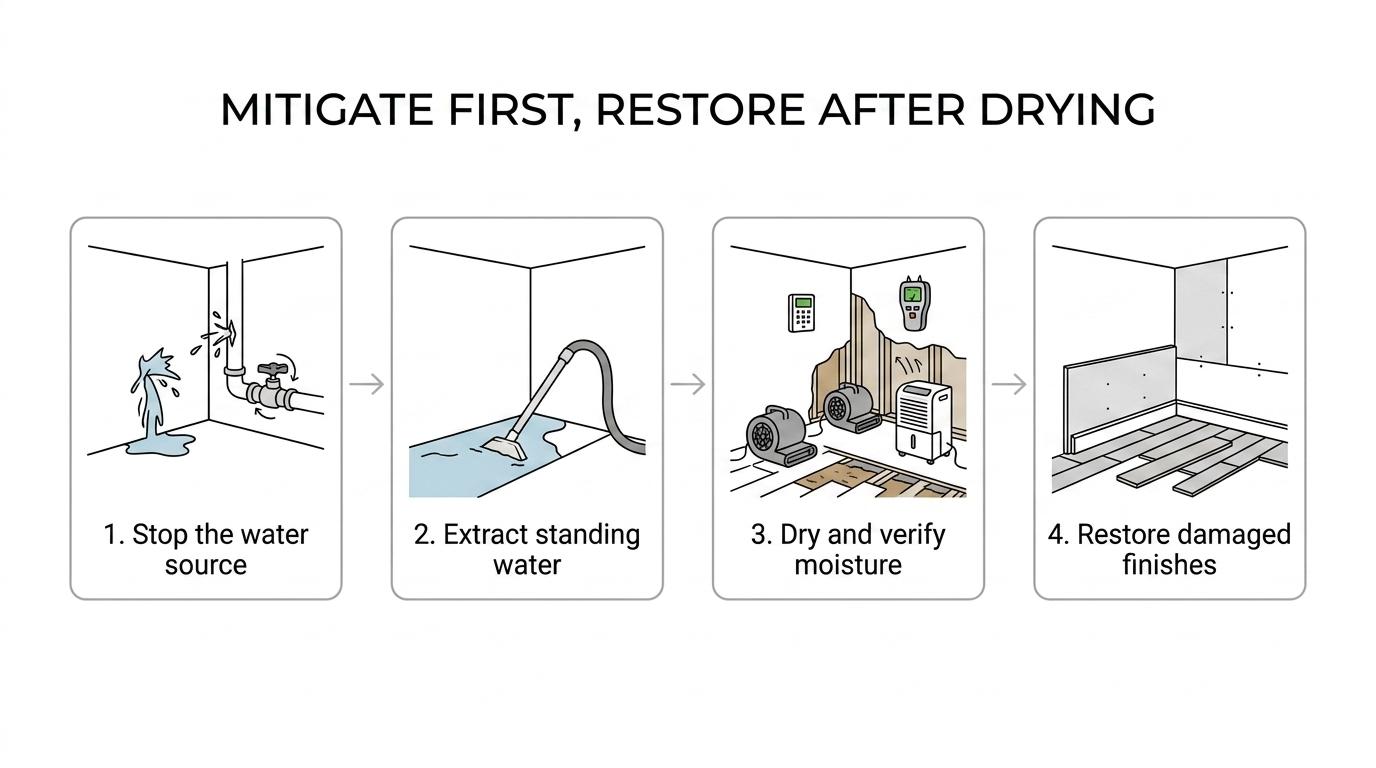
- Correct sequence: Stop water intrusion, extract water, dry materials, sanitize as needed, remediate mold if present, then restore finishes.
- Critical deadline: EPA guidance says water-damaged areas and items should be dried within 24-48 hours to reduce mold risk.
- Main decision point: If moisture readings stay high, restoration should wait because paint, flooring, and drywall repairs can trap moisture.
- Florida context: In Tampa, Clearwater, Largo, and Apollo Beach, humidity and storm exposure can stretch drying time if dehumidification is not set correctly.
- Health and safety: Black mold can be serious, but not all black-colored mold is toxic; color alone is not a reliable risk assessment.
What comes first: water mitigation or restoration?
Water mitigation comes first in Tampa and Clearwater because drying and moisture control must happen before repairs.
Mitigation is the emergency and stabilization phase. It includes stopping the water source, extracting standing water, setting drying equipment, and preventing the damage from spreading into adjacent rooms, cabinets, insulation, or HVAC components. Restoration is the repair phase that follows stabilization.
The reason this sequence is so widely accepted is simple: wet buildings keep changing. The EPA says the key to mold control is moisture control, and water-damaged areas should be dried within 24-48 hours. CDC guidance also points back to the amount and location of water damage when deciding what mold clean-up is needed.
“Tampa Bay Mold & Flood provides 24/7 emergency response for water intrusion and flood clean-up across the greater Tampa Bay area.”
If mitigation is delayed, restoration costs often rise because drywall softens, trim swells, adhesives fail, and microbial growth can spread behind surfaces that still look intact. A common mistake is assuming that once visible water is gone, repair work can begin. Hidden moisture is usually the deciding factor.
What is water mitigation, and what is water restoration?
Water mitigation is damage control, while water restoration is the repair and rebuild phase.
Mitigation focuses on limiting immediate loss. That means source control, water removal, controlled demolition of unsalvageable wet materials when needed, dehumidification, air movement, cleaning, and moisture verification. Restoration begins after the structure is dry enough for replacement materials and finish work.
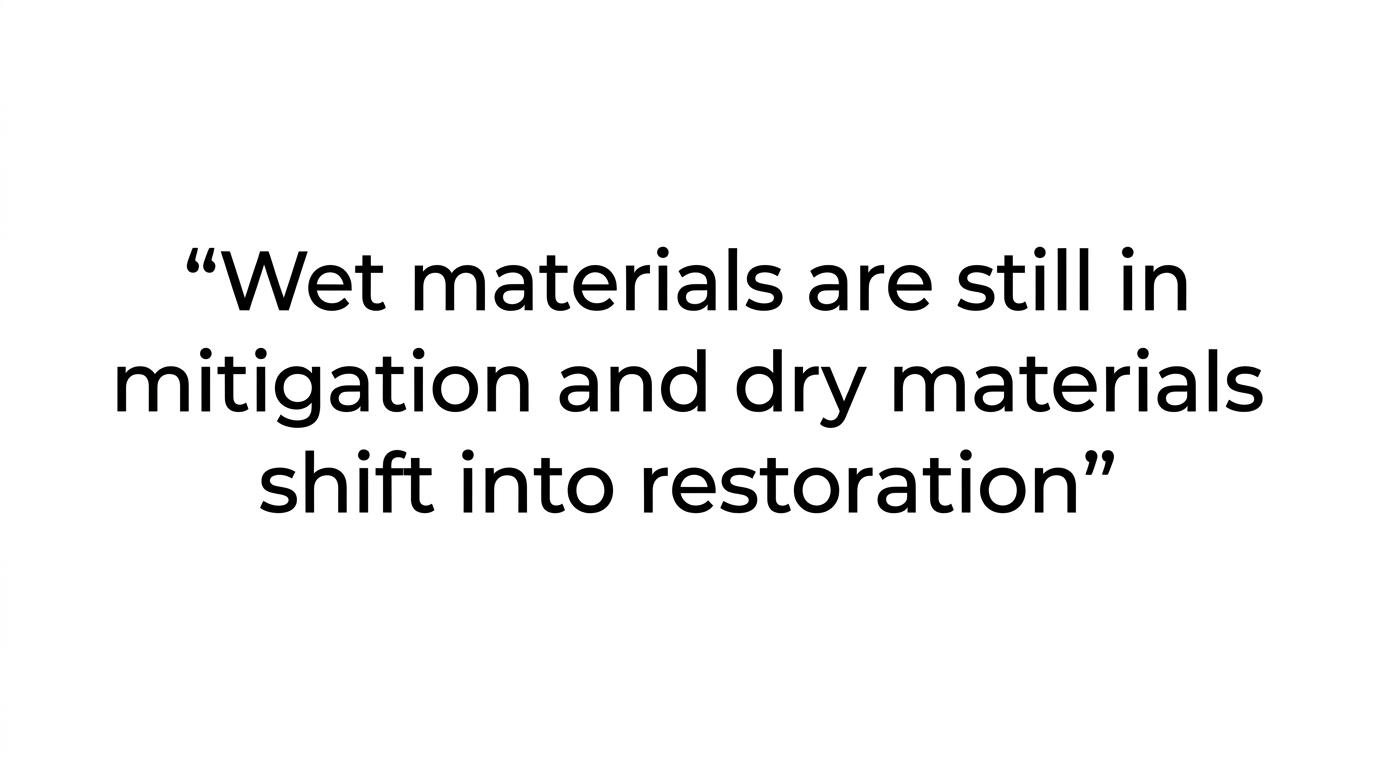
In practice, the two phases can overlap at the handoff point. A crew may finish drying one room while planning baseboard replacement in another. Even then, the logic stays the same: if a material is still wet, it is still in mitigation. Once drying goals are met, it shifts into restoration.
A useful way to think about it is this: mitigation protects the building; restoration returns the building to function and appearance. If someone skips that distinction, they often confuse new paint or flooring with actual recovery.
What are the first calls to make after water damage in Tampa Bay?
The first calls should go to a mitigation contractor, the source-repair trade, and the insurer.
In Tampa Bay, the smartest call sequence depends on whether the loss came from plumbing, roofing, HVAC, appliances, or stormwater. The goal is to stop active damage, document the cause, and begin drying before mold gets a foothold.
- Tampa Bay Mold & Flood
- Plumber, roofer, or HVAC contractor
- Insurance carrier or adjuster
- Electrician if outlets, panels, or wiring may be wet
- Indoor environmental professional if contamination is extensive or recurring
That order keeps the claim, the cause, and the cleanup moving together. In Brandon, Riverview, St. Petersburg, and Palm Harbor, a fast source diagnosis often saves cabinetry, flooring transitions, and nearby drywall from a much larger tear-out.
How does a professional water mitigation process work step by step?
A professional mitigation process starts with inspection, source control, and moisture mapping before drying equipment is set.
First, the affected area is inspected to identify the source of water intrusion, the category of water, and the likely migration path. Moisture meters, thermal imaging, and visual inspection help locate wet drywall, subfloors, insulation, or framing that may not show obvious staining.
Next comes extraction and controlled demolition when needed. Then the drying plan is set using psychrometry and drying technology. That means the team tracks temperature, relative humidity, and material moisture so dehumidifiers and air movers are not just running, but actually moving the structure toward dry standard.
“Tampa Bay Mold & Flood starts with inspection and assessment to identify the scope of the issue and the source of moisture.”
The last part is verification, cleaning, and documentation. This is where insurance support becomes easier, because daily readings, photos, and equipment logs show whether the structure is responding. Pro tip: more fans are not always better. If humidity is not being controlled, extra airflow can push moisture into other materials rather than solve the problem.
How does mold remediation fit into the timeline after water damage?
If water damage is recent and the structure is dried quickly, mold remediation may be limited or not needed at all. If the leak was hidden, repeated, or left unresolved, microbial growth may require a separate containment and removal phase before rebuilding starts.
That phase often includes containment barriers and air scrubbers to keep spores from spreading during removal. Porous materials with active growth may need removal, while some semi-porous or non-porous materials may be cleanable. If moisture readings are still elevated, remediation can become a short-term fix because the mold-friendly condition remains in place.
“Tampa Bay Mold & Flood uses containment barriers and air scrubbers before safe mold removal and restoration.”
This is where people often mix up cleanup with cure. Wiping visible mold off a wet wall is not remediation if the wall cavity is still damp. The water problem has to be corrected first or the growth can return behind the finished surface.
How do professionals decide what can be dried and what must be removed?
Drying versus removal depends on material type, contamination level, and exposure time.
Non-porous materials like metal or some tile surfaces are often good candidates for cleaning and drying. Porous materials like insulation, ceiling tile, and some particleboard products are less forgiving, especially after contaminated water exposure or prolonged saturation. Drywall sits in the middle: sometimes dryable, often partially removable, always moisture-tested.
The category of water matters just as much as the material. Clean water from a supply line is different from gray water from an appliance overflow, and both are different from sewage or storm surge. If contamination is significant, removal thresholds rise because cleaning alone may not be enough.
A common misconception is that antimicrobial technology can replace drying or demolition. It cannot. Antimicrobials can support a remediation plan, but they do not reverse swelling, structural weakening, or contamination trapped inside porous materials.
How fast can mold start after a leak or flood in Tampa Bay?
Mold can begin growing quickly, and EPA guidance uses 24-48 hours as the key response window.
Tampa Bay’s heat and humidity can make that window especially unforgiving. In places like Apollo Beach, Holiday, New Port Richey, and Spring Hill, moisture can stay trapped in carpet pad, wall cavities, and HVAC systems even when the floor surface feels dry.
If the leak is minor and the material dries promptly, mold risk drops sharply. If the leak is hidden behind cabinetry, under luxury vinyl plank, or inside a return plenum, growth can spread long before a homeowner sees a dark spot or smells mustiness. That is why moisture mapping matters more than surface appearance.
Is black mold always toxic after water damage?
No, black mold is not always toxic, and color alone does not identify risk.
Many molds can appear dark green, brown, or black on wet building materials. One well-known species, Stachybotrys chartarum, is often described as black mold, but not every dark patch is Stachybotrys, and not every black-looking mold carries the same health concern.
The safer rule is this: any visible mold points to a moisture problem that needs correction. Testing can be useful in some cases, especially when the source is unclear or liability is involved, but color by itself should not drive the cleanup decision. The real priority is source control, drying, and proper remediation if growth is present.
How is mitigation different after a clean-water leak versus sewage or floodwater?
Clean-water losses are managed differently from sewage and floodwater because contamination changes the salvage plan.
A broken supply line in Lakeland is not handled the same way as stormwater intrusion in St. Petersburg or a sewage backup in Port Richey. Clean-water events may allow more materials to be dried and retained if response is fast. Sewage and outdoor floodwater usually require more aggressive removal, cleaning, PPE, and disinfection measures.
Time also changes the equation. Water that begins as relatively clean can degrade after sitting, moving through building materials, or mixing with contaminants. If the property has been wet for days, the plan may start to resemble a contamination loss even if the original source was a simple plumbing failure.
“Tampa Bay Mold & Flood is a locally owned Florida company with over 12 years of experience in mold remediation and water damage clean-up.”
That is why flood clean-up after coastal storms in Clearwater Beach, Largo, or Apollo Beach often turns into a broader mitigation and mold-prevention project, not just water removal. The source, the duration, and the materials all shape the scope.
What should Tampa Bay property owners do in the first 24 to 48 hours?
Property owners should focus on safety, documentation, and professional drying in the first 24-48 hours.
First, stop the source if it is safe to do so. Shut off the water supply, isolate the appliance, or place a temporary tarp if roof intrusion is obvious and conditions are safe. Next, photograph affected rooms, contents, and visible moisture marks for insurance and scope review.
Then remove movable items, improve airflow only if contamination is not suspected, and call a licensed mitigation team. If the water touched outlets, wiring, or the electrical panel, treat that as a separate hazard. Pro tip: do not assume a household fan solves the issue. Without dehumidification and moisture verification, it can leave wet framing and subfloors behind.
Which Tampa Bay areas often need fast water mitigation and mold follow-up?
Storm-prone and humid areas across Hillsborough, Pinellas, Pasco, Polk, and Hernando counties often need rapid mitigation.
In Tampa, Brandon, Riverview, and Wesley Chapel, common triggers include AC drain failures, pipe leaks, appliance overflows, and summer roof leaks. In St. Petersburg, Clearwater, Largo, Palm Harbor, Holiday, New Port Richey, and Port Richey, wind-driven rain, coastal flooding, and older building stock can add complexity. Lakeland and Spring Hill also see recurring issues tied to plumbing failures and prolonged humidity after storms.
Local response matters because the drying plan has to match the building and the climate. A condo in Clearwater with limited air exchange behaves differently from a single-family home in Land O’ Lakes or a commercial suite in Tampa. The order still stays the same in every case: mitigate first, restore second, and remediate mold when moisture history or visible growth requires it.
What are common water mitigation FAQs in Tampa Bay?
Yes. Most Tampa Bay property owners ask about timing, insurance, occupancy, and mold risk after water damage.
Does insurance cover water mitigation?
Often yes, but it depends on the cause of loss and policy terms. Sudden accidental water damage is commonly treated differently from long-term neglect, repeated seepage, or excluded flood events. Good documentation during mitigation can help support the claim file.
Can I stay in the home during mitigation?
Sometimes, yes. It depends on the contamination level, the rooms affected, electrical safety, noise from equipment, and whether containment is needed. Large sewage losses, heavy demolition, or major mold remediation can make temporary relocation the safer option.
Should I wait for visible mold before calling?
No. Waiting for visible mold can increase both cost and scope. Musty odor, bubbling paint, warped baseboards, damp carpet, or repeated HVAC condensation are enough to justify a professional moisture assessment.
Is restoration the same thing as remediation?
No. Restoration means repairing or rebuilding damaged finishes and materials. Remediation means correcting contamination, which may include mold removal after the moisture source has been addressed.
How do free estimates and insurance help usually fit into the process?
They work best at the front end. A prompt inspection can define the affected area, identify the water source, and show whether immediate extraction, drying, containment, or documentation for the insurer is needed.